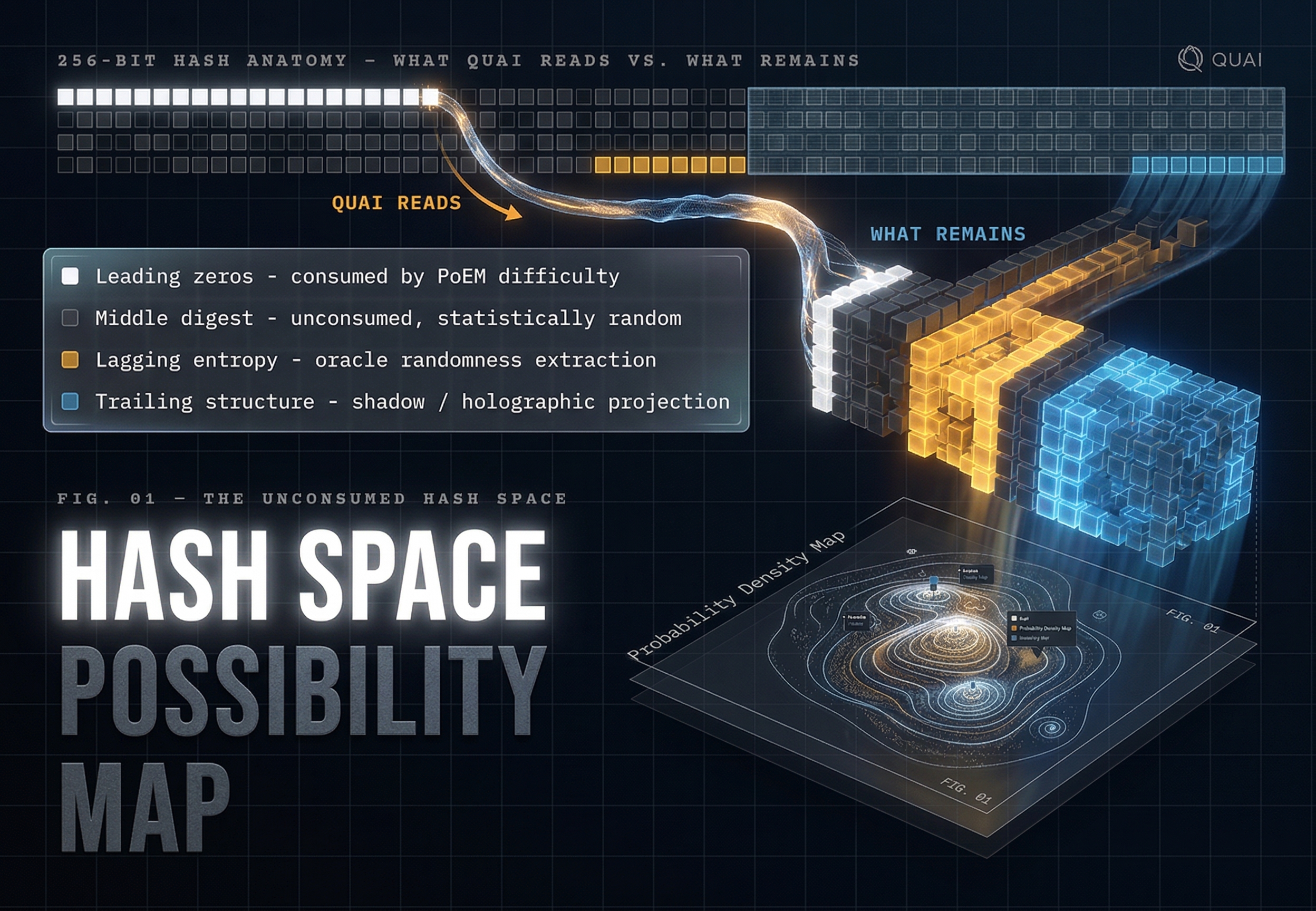
Hash Space Possibility Map
Theoretical Research — Open Space

MORE THAN ONE TRUTH

Every valid Quai hash contains potentially many symmetric or asymmetric truths. PoEM consumes the leading zeros. Everything else — the lagging digits, the trailing structure, the middle entropy — is latent possibility space. Same work already paid for. Different readings not yet taken.

Open Research
Zero Marginal Cost
Quai-Native
01
What PoEM Consumes

The Leading Zeros

Quai's Proof-of-Entropy-Minima reads the number of leading zero bits in a 256-bit hash digest. This count determines workshare tier, block validity, difficulty, and all economic outputs — Qi emission, QUAI reward, and chain ordering. One signal. Deeply used.

What Remains

At Least Half — Possibly All 256

After the leading zeros, the remaining bits are statistically indistinguishable from random. No miner controls them. They cost real energy to produce. They are publicly verifiable and globally timestamped. They are simply never read for any purpose. And the useful region isn't just what's left over — projections can be defined over the entire hash, including the leading zeros themselves. The possibility space is as large as we choose to make it.

The Key Property

Pure Randomness

The unconsumed portion of the hash is not merely unread — it is the highest-quality randomness available on the network. Unpredictable before publication, verifiable after, anchored to physical energy expenditure, and immune to manipulation without redoing the work. No oracle can match this.

The Implication

Any Rule Applied Here Is Free

Any constraint, projection, or reading applied to the unconsumed hash space costs the network nothing. The work is already done. The miner is already paid. What emerges from defining a new rule over this space is not a cost — it is a discovery of something that was already there.

CENTRAL CLAIM
QUAI HASH SPACE — DRAFT THESIS

The Timescale Question

Pure randomness makes possible any slice or sampling of the hash with some constraint or rule capable of being found or produced. What matters is the timescale at which you need the signal to occur — and what use case that timescale solves for. A trailing-ones count produces an infrequent high-value signal. Lagging non-zero digits produce a high-frequency low-latency signal. The hash space supports both, and everything in between, simultaneously.

02
Fig. 02 — Workshare hash: what each region means 256-BIT SHA-256 DIGEST
0000 0000 0000 0000 0000 1 0 1 1 0 0 1 0 1 1 0 1 0 0 1 1 1 0 0 1 0 1 0 0 1 1 0 1 0 1 0 0 1 0 1 1 0 1 1 0 0 1 0 1 3f 8a 2c 91 eb 47 d0 6c 1 1 1 1 1 1 1
Region
Leading Zeros
PoEM reads this as
Difficulty / workshare tier
Economic output
Qi emission · block reward · chain ordering
Status
Fully consumed
Region
Middle digest
PoEM reads this as
Nothing
Economic output
None assigned
Status
Unconsumed — statistically random
Region
Lagging non-zero digits
Projection reads this as
Entropy seed for oracle feeds
Application output
Verifiable randomness · node reputation
Status
Workshare Oracle — prototype live
Region
Trailing structure
Projection reads this as
Shadow difficulty / holographic chain
Application output
Alternate validity condition · entropy maxima
Status
Quai's Shadow — theoretical
The Projection Principle — Formal Statement DRAFT — UNVERIFIED
PoEM — What It Reads
D = CLZ(H)
Count Leading Zeros of hash H. This single integer drives the entire Quai economic system. ~236 bits of H are never examined.
+
Remainder — What It Ignores
R = H & ((2256−D) − 1)
All bits after the leading zeros. Uniformly distributed. Energy-anchored. Already paid for. Available for any projection P(R) at zero marginal cost.
Example Projection A — Oracle
Poracle(H) = H mod 2k
Extract the k lowest-order bits as an entropy seed. High frequency — every workshare. Low latency. Suitable for randomness, price feeds, sampling.
|
Example Projection B — Shadow
Pshadow(H) = CLZ(~H)
Bitwise NOT H, then count leading zeros. Low frequency — only when trailing ones accumulate to difficulty D. Suitable for chain-level constructions.
03
01
WORKSHARE ORACLE
Proto-15 · Deployed Concept
▲ Lagging entropy region
// Mechanism
Lagging Non-Zero Digits → Entropy Feed

Every workshare hash already satisfies a difficulty threshold via its leading zeros. The remaining digits — the lagging non-zero sequence — are statistically indistinguishable from random. Extract them. Use them as oracle inputs. One hash computation. Two outputs. Workshares are produced every few seconds across every active zone, yielding a continuous high-frequency entropy stream.

// Why It Matters
No Oracle Dependency

Projects currently rely on Chainlink or similar trusted feeds for randomness. Workshare entropy is superior: unpredictable before publication, verifiable after, anchored to real energy cost, and impossible to manipulate without redoing computational work. The entropy stream also serves as node reputation — a continuous proof of live operation that cannot be spoofed cheaply.

02
QUAI'S SHADOW
Theoretical · Spec 0.1
▲ Trailing structure region
// Mechanism
Trailing Ones → Shadow Validity Condition

Flip the hash via bitwise NOT: H' = ~H. Now count leading zeros of H'. This is equivalent to counting trailing ones of H — a structurally symmetric difficulty condition. At difficulty D, the probability of satisfying the shadow condition is identical to the probability of satisfying the Quai condition: 2−D. Same statistical work. Opposite end of the digest. A complete alternate validity condition for zero additional energy.

// Why It Matters
Entropy Maxima vs. Minima

PoEM selects entropy minima — the most ordered state reachable from the most work. The shadow condition may select entropy maxima — the most disordered valid state. Together they bound the full thermodynamic range of the computation. Dual-valid blocks satisfying both conditions simultaneously are rare (probability 2−2D) and may represent points of thermodynamic symmetry — natural anchors between the two readings.

03
NODE IDENTITY LAYER
Conceptual · Unexplored
▲ Cumulative stream
// Mechanism
Continuous Entropy Stream → Proof of Identity

A node producing an unbroken stream of verifiable workshare outputs over time creates a unique statistical fingerprint. The cumulative distribution of its hash outputs is measurable, timestamped, and expensive to fake. No two nodes produce identical streams. The stream cannot be pre-computed, replayed from a different point in time, or generated without actively hashing. It is a native Sybil-resistance mechanism requiring no separate identity infrastructure.

// Why It Matters
Signal in a Dark P2P Space

In a fully decentralized P2P network, finding trustworthy nodes is the hardest cold-start problem. Any node can claim to be reliable. Most are noisy, stale, or adversarial. A node with a live entropy stream is demonstrably online, demonstrably doing real work, and demonstrably on the canonical chain. The entropy stream is the credential — cheap to verify, expensive to fake. Finding signal in a dark P2P space becomes physics, not guesswork.

04
ELEMENTARY CELLULAR AUTOMATA
Theoretical · Wolfram Physics
▲ Full hash as initial condition
// Mechanism
Hash Bits → ECA Initial Condition → Rule Evolution

Treat the 256-bit hash output as the initial row of a Wolfram Elementary Cellular Automaton. Apply a chosen rule — Rule 30 for cryptographic-quality randomness, Rule 110 for universal computation — and evolve forward. Each workshare produces a fresh, unpredictable, energy-anchored seed. The ECA evolution is deterministic and publicly reproducible from the hash alone. Anyone with the hash can verify the full output sequence. No trusted party. No additional computation cost beyond the hash already produced.

// Why It Matters
Rule 30 · Rule 110 · Universal Substrate

Rule 30 is Wolfram's canonical pseudorandom generator — its center column passes statistical randomness tests that many purpose-built PRNGs fail. Seeded by a PoW hash, it produces a randomness stream no adversary can predict without solving the hash first. Rule 110 is more profound: it is a proven universal Turing machine. A hash-seeded Rule 110 evolution can, in principle, perform any computation — slowly, but verifiably and without trust. This means the unconsumed hash space is not merely a randomness source. It is a substrate for arbitrary verified computation, anchored to proof of work, running on top of Quai's existing mining with no additional energy cost.

04
DESIGN PRINCIPLE
READING vs. RANKING

Not Every Pattern Is the Same Kind of Useful

Every entry below is a constraint that can be evaluated against a valid Quai hash at zero marginal cost. But patterns serve two fundamentally different purposes — and conflating them is a design error.

Reading — extracting a signal for an application: oracle feeds, randomness, node identity, ECA seeding. These patterns don't need a clean probability model. They just need to be unpredictable, verifiable, and useful at the right timescale.

Ranking — selecting a canonical chain state through consensus. These patterns must satisfy a harder set of requirements: easy to verify, impossible to bias except by brute force, precisely rankable, stable across all nodes, and calibratable for difficulty adjustment. The probability of producing the pattern must be derivable cleanly — otherwise difficulty adjustment becomes swampy.

Leading zeros won historically because the probability is gloriously simple: P(n leading zeros) = 2⁻ⁿ. Any candidate ranking pattern must clear that same bar. The catalog below marks each pattern Tractable — clean probability model, consensus-viable — or Swampy — interesting, but the math gets murky under difficulty adjustment.

Pattern Catalog — Hash Possibility Space 100 patterns
05
THESIS

One Hash. Many Constructions.

Any rule, constraint, or projection applied to the unconsumed region of a valid Quai hash defines a new useful construction — at zero marginal cost to the network. The relevant design questions are not whether it is possible, but what timescale the construction operates on, what use case that timescale serves, and whether the signal is frequent enough to be practical for that use case. The examples above operate across three different timescales: every workshare (seconds), every shadow-valid block (rare), and the cumulative stream over time. Each occupies a different part of the possibility space. None of them conflict. All of them are already being produced.

Construction Hash Region Timescale Use Case Status
PoEM DifficultyThe existing system Leading zeros Every workshare (~seconds) Block validity · Qi emission · chain ordering Live
Workshare OracleProto-15 Lagging non-zero digits Every workshare (~seconds) Verifiable randomness · oracle feeds · DeFi Prototype
Node IdentityEntropy stream fingerprint Cumulative stream distribution Continuous / statistical P2P trust · Sybil resistance · oracle reputation Conceptual
Shadow ChainQuai's Shadow spec Trailing ones (via NOT) Shadow-valid blocks (rare at high D) Entropy maxima · holographic chain construction Theoretical
Cross-Zone SyncUnexplored Relational — simultaneous zone hashes Block height coincidence Coordination primitive · timing anchor Open question
Middle-Band SamplingUnexplored Arbitrary bit-window within digest Defined by sampling rule Parameterized randomness · application-specific feeds Open question
ECA Rule 30Hash-seeded pseudorandomness Full 256-bit hash as initial row Every workshare (~seconds) High-quality PRNG · statistical randomness · sampling Theoretical
ECA Rule 110Universal Turing machine substrate Full 256-bit hash as initial condition Computation-depth dependent Verified arbitrary computation · trustless execution Theoretical
Workshare Oracle — Proto-15 Quai's Shadow — Spec 0.1 Thermoeconomics Research
06
Q.01

How Many Projections?

Is there a principled upper bound on the number of independent useful constructions that can be defined over a 256-bit hash? Or is the possibility space effectively unlimited, constrained only by the imagination of the designer and the timescale requirements of the use case?

Q.03

Do Projections Interfere?

If multiple constructions are reading different regions of the same hash simultaneously, can they create perverse incentives for miners? Could a miner optimize for a shadow condition or oracle output in a way that subtly degrades PoEM's entropy-minimization property?

Q.02

Zone vs. Region vs. Prime?

Zones produce workshares and are the source of hash randomness. Region and Prime are header chains with accounting roles. Does the optimal projection depend on which layer of the hierarchy produces it? Do region and prime headers enable projection types that zone hashes cannot?

Q.04

Wolfram as the Consumer?

If the hash possibility space is a stream of free verifiable randomness at multiple timescales, is Wolfram Mega Oracle the natural aggregator of all projections — treating each construction as a separate entropy channel feeding deterministic computation?

THERMOECONOMIC NOTE

Physics as Infrastructure

PoEM selects for entropy minima — the most ordered state reachable from the most work. The unconsumed hash space encodes everything PoEM did not need to reach that state. It is, in thermodynamic terms, the dissipated degrees of freedom. Putting them to use is not a modification of the system. It is a more complete reading of the physics that was already happening. The work was already done. The energy was already spent. The question is only how much of what was produced we choose to look at.